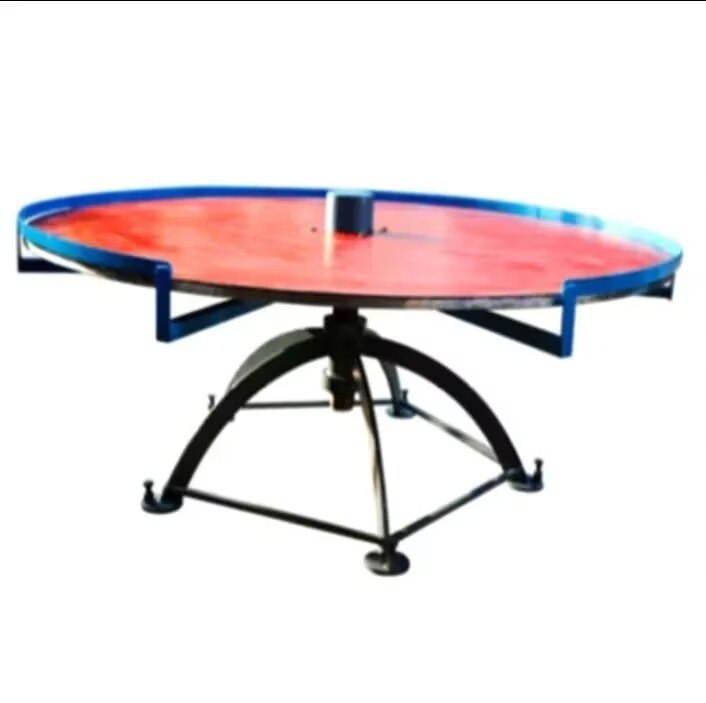
A quotation for a rotary plate form can describe anything from a complete rotary footwear moulding machine to a rotating table with little more than its drive and controls. By checking the included hardware, operating figures, machine interfaces, utilities, and excluded accessories, you can compare offers without mistaking a platform for a complete production line.
Key takeaways
- Request station count, mould carriers, indexing drive and locking mechanism.
- Check plate diameter, load capacity, indexing time and mould-holder dimensions.
- Confirm machine interface, heating connections, sensors and control-panel scope.
- Compare rotary platforms with fixed tables, shuttle systems and complete rotary machines.
What hardware should a rotary plate form quotation include?
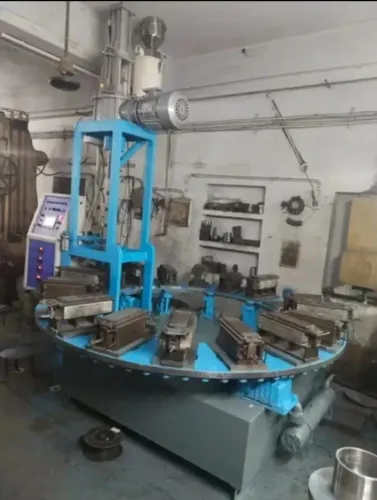
1. Ask the supplier to list the rotary plate form included features: rotary table or plate, station count, mould holders or carriers, indexing drive, locking mechanism, control panel, electrical cabinet, sensors, safety guards, operator controls, and heating connections.
Confirm whether table-position sensors, lubrication components, hydraulic cylinders, a hydraulic power pack, pneumatic valves, and air-preparation equipment are included.
2. Separate the rotating platform from the moulding equipment. A platform-only quotation can exclude moulds, mould bases, injection and clamping units, ejector, cooling circuit, hopper, pump, motor, wiring, installation, and commissioning. Treat “complete machine” as incomplete until every item appears in the packing list.
3. Confirm what comes with rotary plate form in New Delhi by checking the injection package. It should identify the screw and barrel, nozzle, barrel-heating zones, thermocouples, shot measurement, and holding-pressure control. Production moulds are normally separate unless the offer states the shoe-size range, cavity count, upper type, sole design, material, and interchangeable inserts.
4. Mark every utility as included, optional, or customer-supplied. Ask specifically about cooling or temperature-control equipment, air dryers, hopper loaders, colour dosing, granulators, conveyors, extraction, spare heater bands, and spare thermocouples. A complete rotary footwear moulding machine combines the table with injection or dosing equipment, mould clamping, controls, and supporting utilities.
Which dimensions and figures determine whether the platform will work?
A mould that fits the plate diameter can still fail at the nozzle if its usable area, height, or mounting position is wrong. Require these rotary plate form machine details in writing:
- Plate diameter and usable mould area
- Maximum mould length and width
- Maximum mould height and mould-height adjustment range
- Allowable mould weight per station and total table load
- Station count, indexing angle, indexing time, locking method, positioning repeatability, platen parallelism, and permissible cycle rate
| Station count | Production benefit | Cost or risk |
|---|---|---|
| Fewer stations | Lower table diameter, mould investment, floor space, and maintenance points | Loading, injection, cooling, demoulding, and inspection compete for time |
| More stations | These operations can occur at separate positions | Larger table, longer indexing path, more moulds, and more components to maintain |
The offer must name the drive: servo motor, geared motor, hydraulic drive, mechanical indexer, or pneumatic system. Ask for repeatability in millimetres, not merely “precision”; poor positioning causes flash or nozzle misalignment.
Calculate output as pairs per hour from cycle or indexing time, usable injection stations, cavities per mould, operator loading time, and expected rejects. State every assumption, including efficiency. With one injection station, extra stations support cooling and handling but do not multiply injection output.
Confirm whether the quoted rate includes cooling, demoulding, insert loading, and indexing, or covers only injection and holding. Injection-unit size alone proves nothing about capacity. These figures belong in the rotary plate form included features schedule.
How does the rotary plate form connect to a vertical injection machine?
Connect the platform to a vertical injection machine only after mechanical, electrical, hydraulic, and process compatibility is documented. Rotary footwear moulding equipment can fail through nozzle misalignment, insufficient clamping, or an incomplete control interface.
1. Match platen dimensions, tie-bar clearance, nozzle position, mould-height limits, clamping force, and ejector stroke. Confirm the mould mounting pattern, platen flatness, carrier dimensions, plate-form machine details, and whether an adapter or custom base plate is needed.
2. Require the electrical schedule: supply voltage and frequency, control signals, interlocks, emergency-stop circuits, sensor types, and communication with the injection controller. Require the hydraulic schedule: pressure, flow, hose connections, valve control, oil specification, and whether the platform has its own power pack.
3. Map the full cycle: load inserts; close and clamp; inject; apply holding pressure; cool or cure; release and demould; inspect; index through the stated angle; repeat. Confirm the compound and route, not just a material label. PVC and TPR need a compatible screw, barrel, nozzle, heating profile, injection pressure, and shot weight.
EVA may use injection, compression, or a hybrid route, so specify the EVA grade, density target, foaming system, moulding temperature, and cooling or cure cycle.
Treat “PVC-capable” as insufficient evidence for EVA production. Put every figure and interface in the quotation before ordering either component.
Which controls, safety features, and utilities belong in the offer?
A quotation is ready for safe installation only when it identifies controls, guarding, utilities, and site work—not merely the rotating plate. Treat “rotary plate form included features” as a checklist: recipe storage, temperature-zone control, injection and holding-pressure settings, mould-clamp monitoring, cycle counting, fault alarms, and emergency stops.
Ask whether each displayed value is a measured reading or only a programmed set point.
Require mould-closing guards, interlocked access doors, protection against unexpected table movement, and safe hydraulic-pressure release. Ask how the design addresses ISO 20430:2020. To establish what comes with rotary plate form in New Delhi, require the quotation to mark each item as included, customer-supplied, or optional.
| Utility | Status to mark | Specification required |
|---|---|---|
| Electrical supply | Included/customer/optional | Connected load, voltage, frequency |
| Compressed air | Included/customer/optional | Pressure and consumption |
| Cooling water | Included/customer/optional | Flow and inlet temperature |
| Hydraulic system | Included/customer/optional | Oil specification |
| Ventilation | Included/customer/optional | Exhaust requirement |
Check exclusions explicitly:
- Mould temperature-control units, chillers, air dryers, hopper loaders, colour dosing systems, granulators, conveyors, extraction equipment, spare heater bands, and spare thermocouples.
The offer must also state installation, levelling, wiring, trial production, commissioning, operator training, warranty scope, manuals, and recommended spares. Otherwise, a low machine price can conceal site preparation and delayed production.
How does a rotary plate form compare with other machine choices?
Choose a separate rotary plate form when your mould range and production volume justify multiple stations; otherwise, a fixed vertical machine is easier to run and maintain.
| Machine choice | Main advantage | Main trade-off |
|---|---|---|
| Fixed single-station vertical machine | Less floor space, fewer moulds, simpler maintenance | Loading, injection, cooling, and demoulding happen at one station |
| Rotary plate form with paired injection machine | Separates operations across stations and supports rotary footwear moulding equipment | Requires more moulds, table space, indexing hardware, and maintenance |
| Rotary injection machine with its own injection units | More integrated production package and better process separation | Higher capital cost, more controls, and more components |
| Manually indexed table | Lower purchase cost and direct operator control | Operator timing reduces repeatability and weakens movement safety |
Compare these figures before choosing:
- Changeover time and mould count
- Station access, cleaning effort, and spare-part availability
- Table load, indexing time, and actual pairs per hour
- Cavities per station, cycle time, rejection rate, and assumed operating efficiency
Do not compare injection-unit size alone. Ask how many usable stations produce pairs after loading, cooling, demoulding, and indexing.
When asking a rotary plate form supplier in New Delhi what comes with rotary plate form in New Delhi, provide mould drawings, compound, cavity count, target output, utilities, and paired machine model. Require the offer to separate platform-only items from moulds, injection unit, clamping, cooling, wiring, installation, and commissioning.
Mishra Fabrication belongs in a like-for-like comparison only after it supplies those dimensional, interface, output, safety, and exclusion details.
Related products
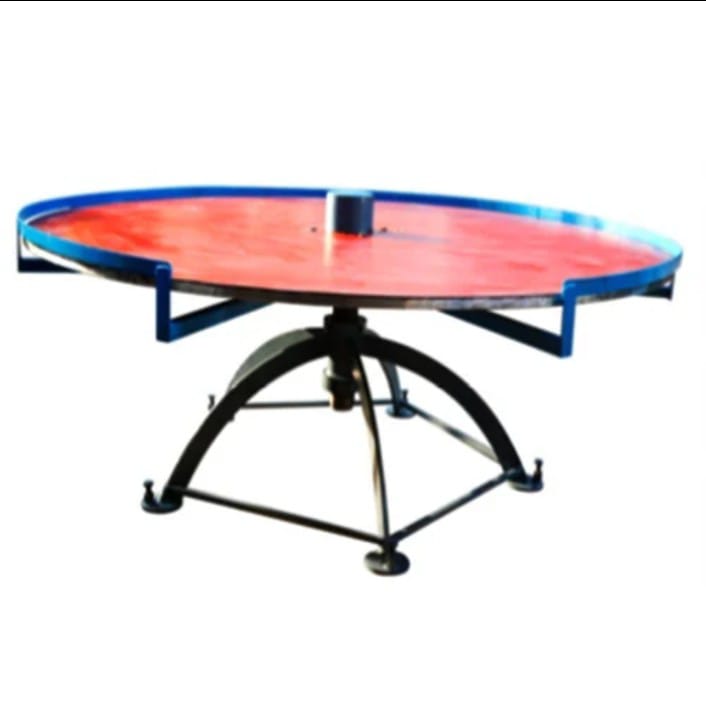 | Roatary Plate Form Rotary Plate Form Rotary Platform is a durable and efficient rotating system designed to support smooth mould rotation and streamlined production... View product → |
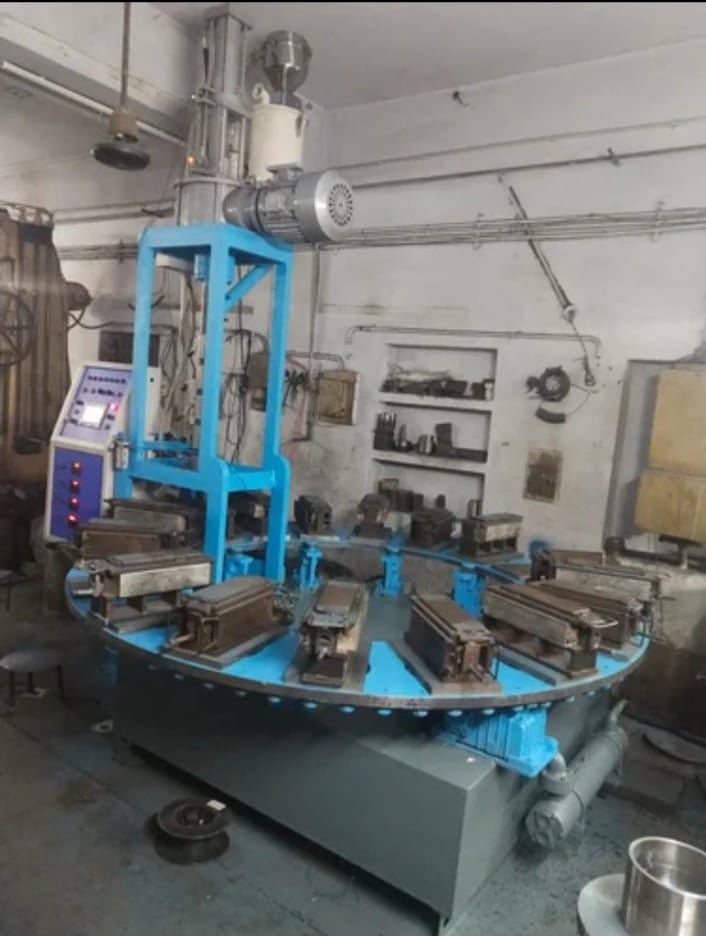 | Automatic Roatary Injection Moulding Machin Automatic Roatary Injection Moulding Machin Automatic Rotary Injection Moulding Machine Automatic Rotary Injection Moulding Machine is designed for high-speed and efficient production of... View product → |
Frequently asked questions
What hardware should a rotary plate form quotation include?
Request the rotary table or plate, station count, mould holders or carriers, indexing drive, locking mechanism, control panel, electrical cabinet, sensors, safety guards, operator controls and heating connections.
Which dimensions and figures determine whether the platform will work?
Check plate diameter, station spacing, mould-holder dimensions, maximum mould weight, working height, indexing time, rotation direction and the vertical injection machine’s available mounting area.
How does the rotary plate form connect to a vertical injection machine?
Confirm the mounting pattern, table height, mould alignment, injection clearance, electrical signals, index-complete interlock and any hydraulic, pneumatic or heating connections.
Which controls, safety features, and utilities belong in the offer?
Ask for the control panel, start and stop controls, emergency stop, guarding, door interlocks, position sensors, electrical rating, compressed-air requirement and heating-circuit details.
How does a rotary plate form compare with other machine choices?
A rotary platform suits repeated multi-station work, while a fixed table offers simpler setup and a shuttle system can separate loading from injection; compare cycle time, labour, floor space and integration effort.
Keywords