The answer depends on saleable pairs per shift, not the machine’s headline injection rate. You will be able to size demand, test a winter mould with the correct PVC or EVA compound, and set a purchase acceptance standard that exposes capacity and quality risks before production begins.
Key takeaways
- Calculate peak pairs from orders, production days, launch stock and reject reserves.
- Match PVC material, product thickness and mould stations before choosing machine capacity.
- Measure cooling, trimming and operator time to find the real production bottleneck.
- Witness a full-load acceptance test using your material, mould and target product.
Start with Delhi demand, then calculate saleable output
Delhi demand must be converted into pairs before you compare machines. Use peak-month orders, selling-season length, retailer replenishment frequency, production days, and the inventory required before cold weather to calculate the peak requirement. Include opening stock for launch and reserve stock for late orders or rejects; do not rely on annual averages.
1. Record peak-month demand in pairs, the number of selling months, and each retailer’s replenishment interval. Convert that programme into pairs required before and during the peak, then divide it by available production days and shifts.
2. For the winter mould, record cavity count, pairs per completed mould cycle, cycle time, and measured yield. Calculate saleable pairs per hour as: pairs per completed mould cycle × completed cycles per hour × yield.
3. Reduce planned shift time for mould changes, setup, cooling, maintenance, operator breaks, rejects, and unplanned downtime. The resulting saleable hourly output, multiplied by available shifts, is the capacity of an automatic rotary vertical injection for winter footwear in Delhi.
A nominal claim of 1,000 pairs per hour cannot be compared directly with 600–800 pairs per eight hours or 700 pairs per eight hours. First record the same product weight, cavity count, cycle time, and reject rate for each test; otherwise, a winter footwear production machine in Delhi is being compared on different definitions.
That is the basis for assessing PVC footwear machine seasonal demand.
The machine can meet demand only when verified saleable output multiplied by available shifts exceeds peak requirement with a defined reserve.
Match the machine to the winter product and mould
A winter slipper manufacturing machine fits a directly injected PVC or EVA slipper, sole, or gumboot only when its mould and compound match the machine. A lined or insulated winter shoe remains a separate assembly: prepare the upper, insert lining and insole, then trim, bond, and inspect it. Automation does not remove those operations.
1. Check the winter mould for deeper cavities, boot shafts, thicker sections, textured soles, and every planned size. Record maximum mould dimensions, cavity count, shot weight, injection volume, screw diameter, projected mould area, and required clamping force.
2. Do not scale a published 23 m/t figure to an unlisted winter mould. Calculate clamping demand from that mould’s projected area and compound pressure data, then retain a pressure safety margin. Confirm the mould fits the platen, rotary clearance, and opening stroke.
3. Treat materials separately. An automatic rotary machine for PVC footwear needs controlled barrel temperature, residence time, purging, and ventilation because overheated or stagnant PVC degrades and releases hydrogen chloride fumes. EVA needs control of expansion, density, shrinkage, and mould venting; the same screw, profile, or mould may fail.
4. Approve the finished product only after low-temperature flexibility, cracking, abrasion, slip, dimensional stability, and sole-to-upper adhesion checks. Test the bond after surface preparation, conditioning or preheating, accurate upper positioning, and injection—not from appearance alone.
A thick boot or textured sole that fills poorly, cracks in cold weather, or loses its upper bond is not technically viable.
Map the rotary workflow and find the real bottleneck
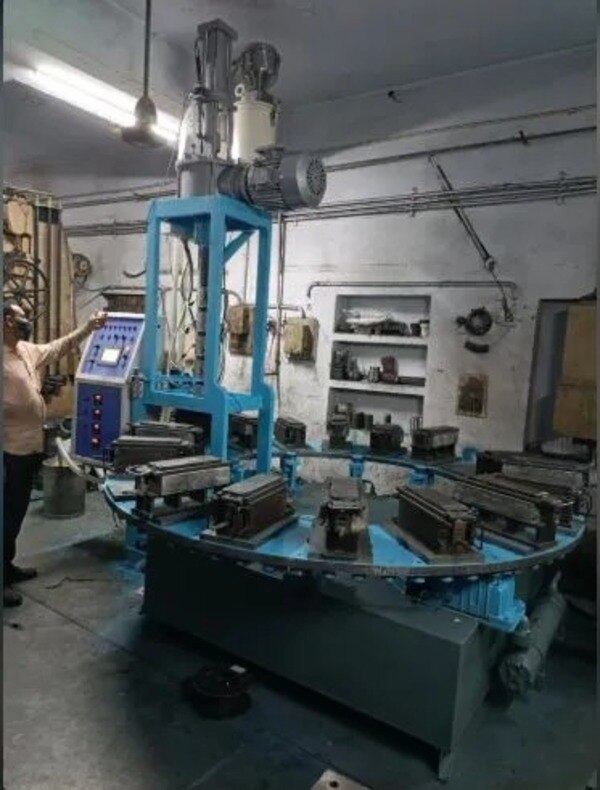
Output is set by the slowest station, not the number of positions on the table. An automatic rotary machine for PVC footwear normally moves through this sequence:
- Condition or dry the approved compound when required, then charge the hopper.
- Load and position the mould.
- Index the rotary table.
- Inject, hold pressure, and cool.
- Demould, unload, trim, inspect, and pack.
Separate stations can handle loading, injection, cooling, and demoulding, but extra stations do not guarantee extra pairs. Indexing time, cooling requirement, plasticising capacity, manual loading, demoulding damage, and the slowest station establish the completed cycle.
| Station | Output limiter | What to record |
|---|---|---|
| Loading | Manual positioning or upper preparation | Operator count and loading time |
| Injection | Plasticising, fill balance, weld lines, flash | Product weight, cavity count, temperature |
| Cooling | Thick sections or deep moulds | Cooling time and shrinkage |
| Demoulding | Sticking, tearing, or distortion | Damage and reject rate |
Require a witnessed run with the winter mould, actual colour and compound, stated product weight, cavity count, cycle time, operator count, and production temperature. Check hardness or density as well as appearance; a warm demonstration can hide winter-process failures.
Guard the rotary table and mould-closing area, fit emergency stops and hot-surface protection, and provide local exhaust. Document PVC purging and cleaning controls. Use ISO 20430 alongside applicable Indian factory and occupational-safety requirements.
Plan seasonal utilisation instead of buying for one peak
Treat pvc footwear machine seasonal demand as a production and inventory model, not a catalogue pairs-per-day claim. Separate peak-month orders from annual utilisation, then plan the stock needed before cold weather and the replenishment work that follows.
- Set launch inventory for the first retailer delivery.
- Set the retailer replenishment interval and peak-month order volume.
- Convert that volume into production days using verified saleable pairs per hour.
- Add a reserve for rejects, mould changes, maintenance, and late orders.
- Compare required shifts with operators, working days, and available machine hours.
| Programme | Products to evaluate | Annual utilisation risk |
|---|---|---|
| Winter-only | Winter slippers or boots in limited sizes | Rotary table sits underused after the season |
| Mixed PVC | Winter styles, sandals, ordinary PVC footwear, and soles | Quick mould changes and multiple sizes improve utilisation |
| PVC plus EVA | Compatible non-winter EVA products after separate trials | PVC and EVA are not interchangeable; process failure can erase the capacity gain |
A higher peak speed cannot justify a machine that runs only for three months. Check changeover time, mould storage, colour cleaning, and whether the same workforce can run the wider range.
Automation also stops at the product boundary. Lining, foam or textile insertion, upper positioning, bonding, trimming, and final inspection can consume more labour than injection; include those minutes in the shift model. For EVA products, run a separate mould and compound trial rather than transferring PVC settings.
Use a witnessed acceptance test before committing
Approve only after a witnessed trial using your mould, approved compound, colour and finished product. For a winter footwear production machine in delhi, put every pass/fail limit in the purchase protocol before the trial begins.
| Measure | Written acceptance evidence |
|---|---|
| Saleable output | Pairs per hour, cycle time, cavity count, yield and reject ceiling |
| Product quality | Dimensional tolerances, hardness or density range, low-temperature flex result and sole-to-upper adhesion |
| Utilities | Electricity and compressed-air consumption at the agreed output |
| Operations | Mould changeover time and maximum permitted manual work per pair |
| Conditions and standards | Results at the lowest practical winter shop-floor temperature; conformity with IS 12254 for PVC sandals and slippers, or the relevant IS 15298 requirement for protective footwear |
Require records of flash, weld lines, shrinkage, fill balance and demoulding damage. A warm showroom sample proves little if cold conditions cause cracking, poor bonding or dimensional drift.
Evaluate Mishra Fabrication through this evidence, not catalogue claims: compare the proposed machine configuration, PVC-specific screw and barrel temperature controls, mould size and shot limits, service-response time, trial records, guarding, ventilation provisions and operator training.
Define who loads uppers, trims edges, inspects pairs and packs them; otherwise “automatic” can hide labour that destroys the capacity calculation.
The decision rule is simple: buy only when witnessed saleable output covers peak demand with the agreed reserve, and every finished-product test passes.
Related products
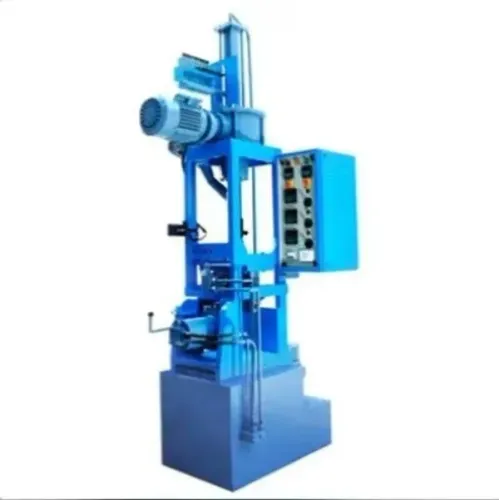
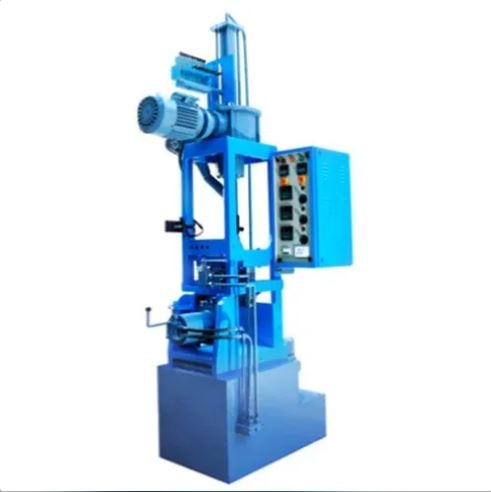 | Vertical Injection Moulding Machine Vertical Injection Moulding Machine ₹500000 Clamping Force 23m/t Material Mild Steel Max. Plasticizing Capacity 60 Kgs/hr Injection Pressure 400 Kgs/cm2 Pump Drive 120 Kgs/cm2 Heating 3.25 K.W. View product → |
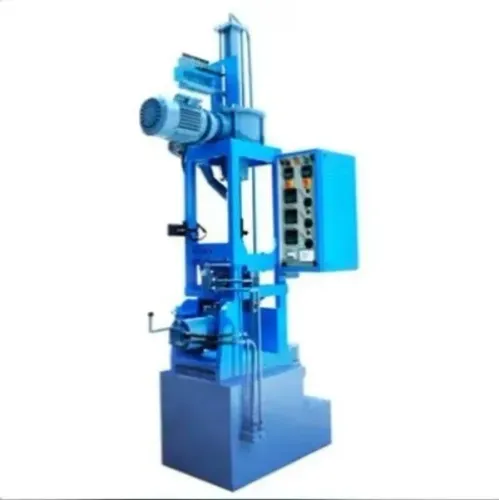
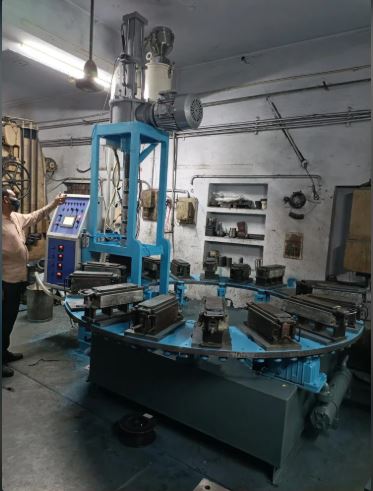 | Injection Molding Machine Automatic Rotary Vertical Injection Moulding machine for all type pvc footwear ₹1850000 Machine Type Vertical Injection Moulding Machine Material PVC Automation Grade Automatic Brand RAM Country of Origin Made in India Application For... View product → |
Frequently asked questions
How do you calculate Delhi’s peak winter footwear requirement?
Multiply peak-month orders by the selling-season replenishment cycle, then add launch stock and reserve stock for late orders and rejects. Divide the result by available production days to find required saleable pairs per day.
What should you match before choosing a winter footwear production machine?
Match the machine’s injection capacity, clamping force, station count and cycle time to the PVC formulation, product thickness, sole pattern and mould dimensions. Confirm that the mould fits the rotary table and produces the required pair configuration.
What is the real bottleneck in an automatic rotary machine for PVC footwear?
Injection is not always the limiting step. Measure mould loading, cooling, demoulding, trimming, inspection, packing and material handling separately; the slowest linked operation sets saleable output.
How should you plan seasonal utilisation for a winter slipper manufacturing machine?
Base the purchase on profitable work across the year, not only Delhi’s winter peak. Identify summer footwear, slippers, soles or other PVC products that use compatible moulds and material before committing to peak capacity.
What should a witnessed acceptance test include?
Run your intended PVC material, production mould and target product at the agreed settings. Record cycle time, reject rate, pair weight, dimensions, flash, surface finish, demoulding performance and continuous-load stability.
Related products
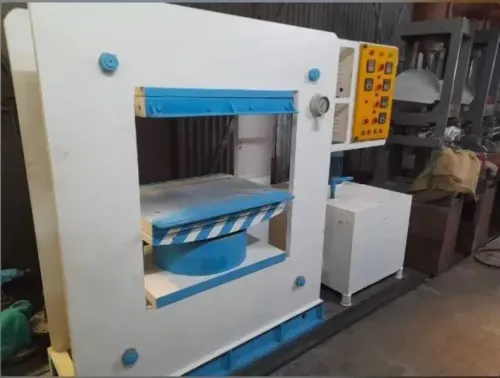
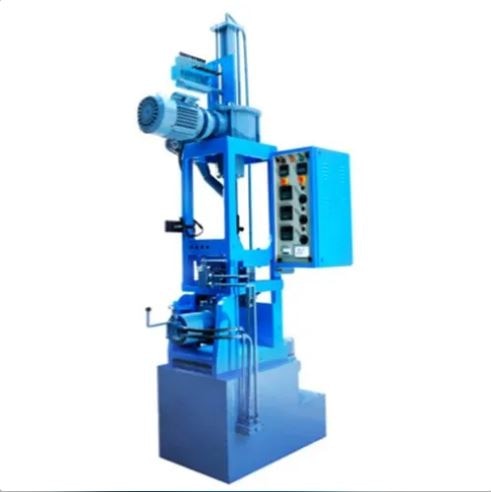 | Vertical Injection Moulding Machine ₹450000 Capacity(Shoes/Day) 600 Production Capacity 1000 pc Country of Origin Made in India Brand Ram Company Mishra Fabrication This shoemaking process... View product → |
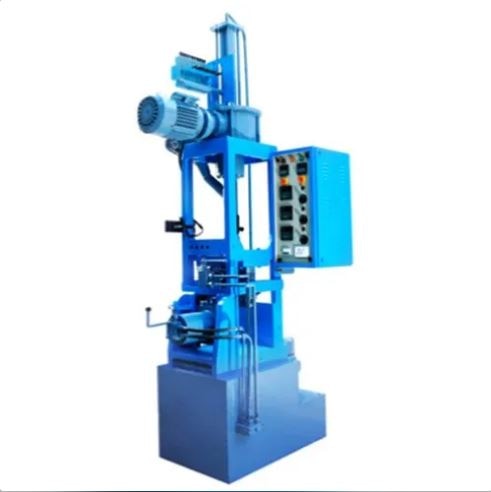 | Footwear Making Machine Footwear & Slipper Making Machine For Pvc ₹450000 Production Capacity 5000 pcs/day Model Name/Number Gumboot Weight 1.8 Ton approx. View product → |
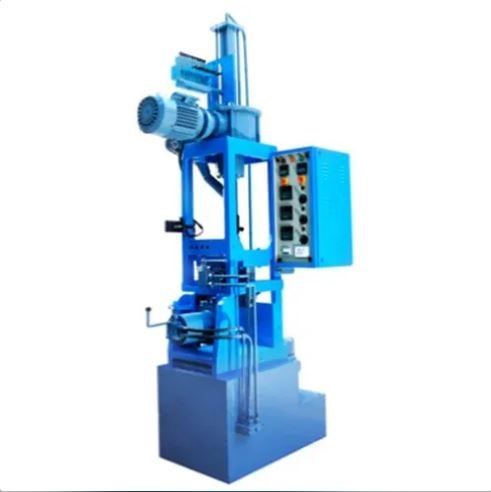 | Footwear Making Machine ₹450000 Brand RAM Power Consumption 21- 22 KW Production Capacity 600 to 800 Per 8 Hours Weight 1.8 Ton approx. View product → |
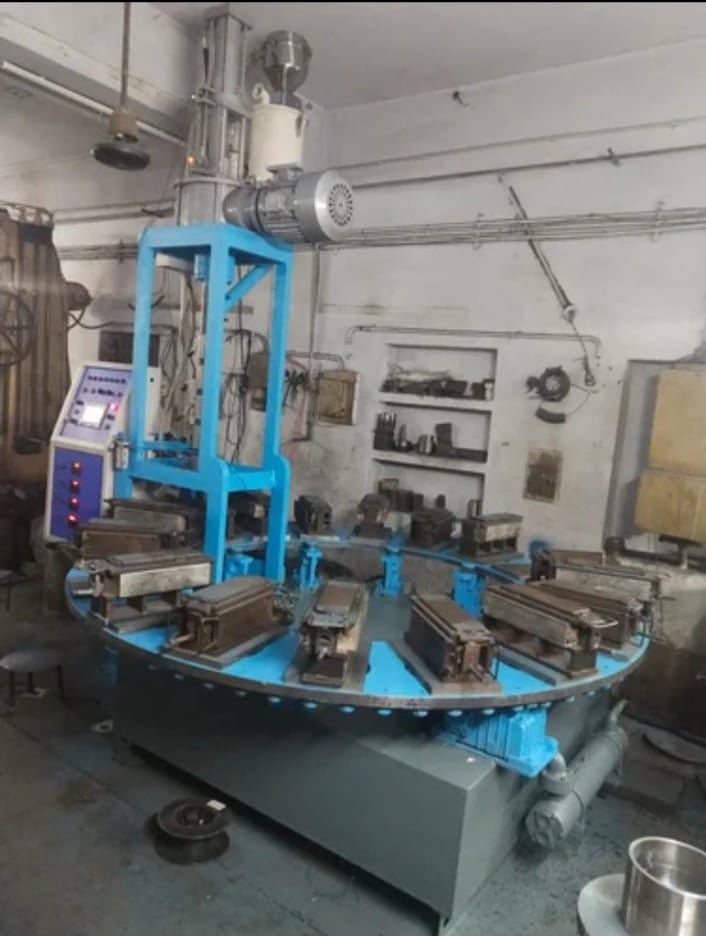 | Automatic Roatary Injection Moulding Machin Automatic Roatary Injection Moulding Machin Automatic Rotary Injection Moulding Machine Automatic Rotary Injection Moulding Machine is designed for high-speed and efficient production of... View product → |
Keywords