

Choosing an injection moulding machine is a major investment for any manufacturing business. The right machine can improve product consistency, shorten production cycles and reduce material waste. A poorly matched machine may create recurring quality problems, consume excess power and limit future production capacity.
Factories searching for the Best Injection Moulding Machine in Delhi NCR should evaluate the machine according to their actual products and operating conditions rather than relying only on price or advertised tonnage.
Begin With the Product You Want to Manufacture
Machine selection should start with the finished component. A machine designed for small footwear accessories may not be suitable for producing larger soles or industrial moulded parts.
Before comparing models, document:
- Product dimensions and weight
- Material to be processed
- Number of cavities in the mould
- Required production volume
- Acceptable cycle time
- Surface finish expectations
- Insert-moulding requirements
- Available factory space
These details help determine the required injection capacity, clamping force and mould size.
Check the Clamping Force
Clamping force keeps the mould closed while molten material is injected. Insufficient force may cause flash, dimensional variation or inconsistent product weight. Excessive capacity, however, can increase purchase and operating costs unnecessarily.
The required tonnage depends on the projected area of the moulded component, cavity pressure and number of cavities. Buyers should ask the manufacturer to calculate the required force using actual product and mould data.
Evaluate Injection Capacity
The injection unit must deliver the necessary material volume consistently. A machine operating close to its maximum shot capacity during every cycle may experience unstable processing and accelerated wear.
Ideally, the expected shot weight should remain comfortably within the machine’s processing range. Screw diameter, injection pressure, plasticising capacity and material compatibility should also be examined.
Consider Automation and Control Features
Modern controls make it easier to maintain stable temperature, pressure, injection speed and cooling time. Recipe storage can reduce setup errors when a factory produces multiple products.
Useful features may include:
- Digital parameter setting
- Multi-stage injection control
- Temperature-zone monitoring
- Automatic fault alerts
- Production cycle counters
- Safety interlocks
- Energy-consumption monitoring
Automation should match the skill level of the operating team. A highly sophisticated control system provides limited value if replacement parts, training or technical support are difficult to obtain.
Calculate the Complete Operating Cost
The lowest-priced machine is not always the most economical. Factory owners should examine electricity consumption, maintenance frequency, tooling compatibility and expected output per shift.
A practical cost comparison should include:
- Machine purchase and installation
- Mould development or modification
- Power consumption per production cycle
- Operator requirements
- Preventive maintenance
- Spare-part availability
- Expected rejection rate
- Production downtime risk
A more efficient machine may justify a higher initial investment when it produces more acceptable parts with lower energy use.
Assess Local Manufacturing Support
Delhi NCR includes major industrial areas across Delhi, Haryana and Uttar Pradesh. Local support is especially valuable when a machine needs commissioning, operator training or urgent troubleshooting.
Prospective buyers should determine whether the supplier can provide installation assistance, trial production, maintenance guidance and commonly required spares. They should also clarify response times for factories in their specific industrial area.
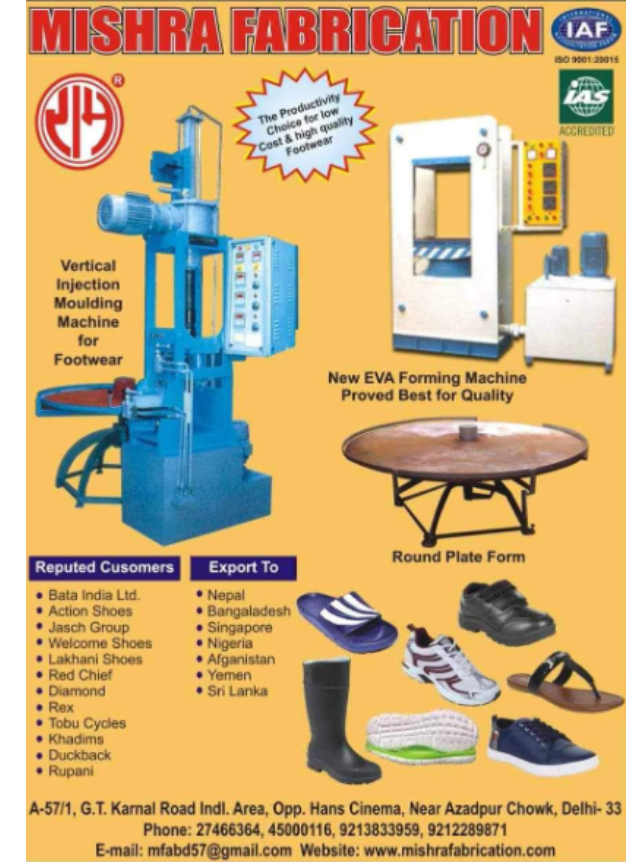
Mishra Fabrication works with footwear and industrial manufacturers requiring machinery selected around practical production needs. Buyers can use product samples, material details and output targets during technical discussions to obtain a more relevant recommendation.
Request a Production Trial
Whenever possible, evaluate the machine using the intended raw material and a comparable mould. Observe cycle stability, product finish, flash formation, material feeding and ease of parameter adjustment.
A successful trial should demonstrate repeatable quality across multiple cycles, not merely one acceptable sample. Recording cycle time, power demand and rejection observations provides a better basis for comparing different machines.
The best injection moulding machine is ultimately the one that matches the product, mould, material, output target and available support. A disciplined technical evaluation helps Delhi NCR manufacturers invest in equipment that remains productive beyond the initial installation.